Tai Chi Walking: The Complete Beginner’s Guide (Is It Legit?)
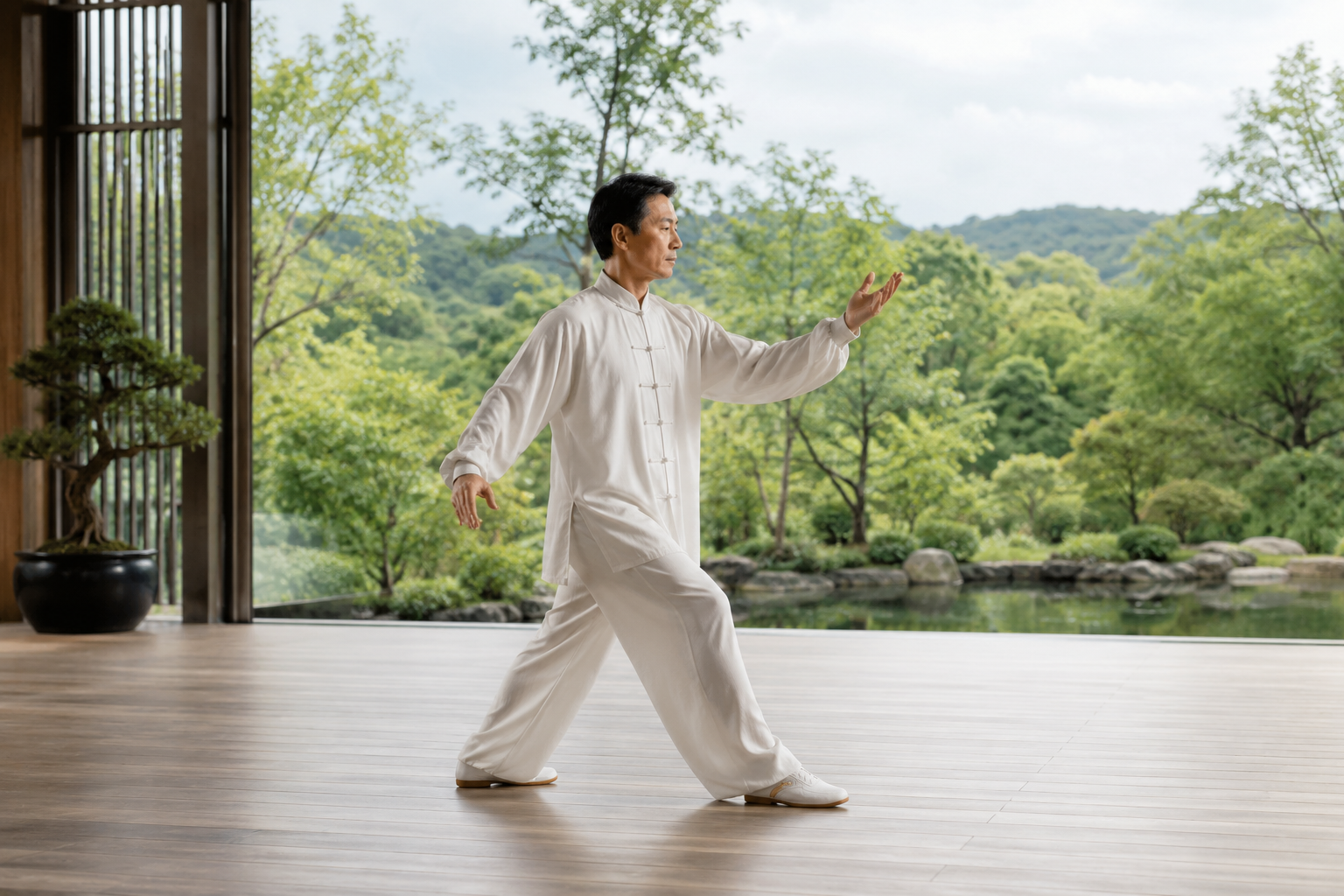
Here’s a sentence you don’t hear often: walking can be a martial art.
Or at least, walking can carry the same principles that make Tai Chi one of the most effective health practices on the planet. And thousands of people are searching for it — "tai chi walking," "tai chi walk," "how to tai chi walk" — every single month.
But what is it? Is it just walking slowly? Is it legit, or another fitness fad? Can it actually help with weight loss? And why is there a separate search for "tai chi indoor walking"?
By the end of this guide, you’ll know exactly what Tai Chi walking is, why people are obsessed with it, and how to start your own practice — today, in your living room, with zero equipment.
What Is Tai Chi Walking?
Tai Chi walking is not just "walking while doing Tai Chi arm movements." It’s a specific training method that applies Tai Chi’s core principles to the most fundamental human movement: putting one foot in front of the other.
In traditional Tai Chi training, walking practice (xingbu, 行步) is a foundational drill. Before students learn any form, they learn to walk correctly — because every Tai Chi movement is built on weight transfer. If you can’t shift your weight properly while walking, you can’t do it in the form.
The Core Idea
Regular walking: you fall forward and catch yourself with each step. It’s efficient, but it’s essentially controlled falling.
Tai Chi walking: you shift your weight deliberately from one leg to the other, emptying one leg completely before stepping. There’s no "falling." Every step is a conscious, balanced transfer of weight — slow, controlled, and rooted.
This sounds simple. It is not easy. Try taking 30 seconds to complete a single step — shifting from 100% weight on your back leg to 100% on your front leg, with no jerky transitions, no wobbling, and your upper body completely relaxed. That’s Tai Chi walking.
Is Tai Chi Walking Legit? (Yes — Here’s Why It Works)
You might be skeptical. "Slow walking" sounds like something your physical therapist prescribes after knee surgery, not a legitimate fitness practice.
But Tai Chi walking works on multiple levels simultaneously:
1. It Rebuilds Your Balance From the Ground Up
Modern footwear and flat urban surfaces have atrophied our balance. Most adults under 40 can’t stand on one leg for 30 seconds with their eyes closed. Tai Chi walking systematically retrains your vestibular system and proprioception — the senses that tell your brain where your body is in space.
For seniors, this is literally life-saving: falls are the leading cause of injury-related death in people over 65. For everyone else, better balance means better athletic performance, fewer injuries, and more confidence in your body.
2. It’s Stealth Strength Training for Your Legs
Moving slow sounds easier than moving fast. It’s the opposite. When you take 10+ seconds per step, your supporting leg is under constant load with no momentum to cheat. Your glutes, quads, and the small stabilizing muscles around your ankles and knees fire continuously.
People who try Tai Chi walking for the first time are shocked at how quickly their legs start burning — and they haven’t even moved their arms.
3. It’s a Moving Meditation That Actually Works
Traditional seated meditation is hard for many people. The mind wanders. The body gets restless. Tai Chi walking gives your brain an engaging task — "shift weight, step, shift, step" — that anchors attention better than a mantra. You can’t think about your email inbox when you’re concentrating on not tipping over.
Tai Chi Walking for Weight Loss: Realistic Expectations
Let’s address the search query directly: "tai chi walking for weight loss."
The honest answer: Tai Chi walking alone will not make you drop 20 pounds. It burns roughly 150–200 calories per 30 minutes — similar to a leisurely bike ride. If weight loss is your only goal, high-intensity interval training (HIIT) or brisk walking burns more calories per minute.
But here’s what Tai Chi walking does that HIIT doesn’t:
- It lowers cortisol. High-intensity exercise spikes your stress hormone. For people whose weight gain is stress-related, Tai Chi walking addresses a root cause that burpees can’t touch.
- It’s sustainable. Nobody does HIIT every day for 30 years. Millions of Chinese seniors do Tai Chi every morning for decades. For long-term weight management, adherence is everything.
- It improves sleep. Poor sleep drives weight gain through hormonal disruption. Tai Chi has been shown in multiple studies to improve sleep quality — especially in older adults.
- It builds a movement habit. The hardest part of weight loss is consistency. Tai Chi walking is so gentle, so pleasant, and so accessible that you actually look forward to doing it. That’s a superpower.
Bottom line: Tai Chi walking is an excellent complement to a weight loss program — and for people who are elderly, obese, injured, or exercise-averse, it might be the only exercise they can stick with. In that context, it’s a game-changer.
Indoor Tai Chi Walking: The Pandemic-Era Trend That Stuck
Searches for "tai chi indoor walking" exploded during COVID lockdowns and never fully went away. The appeal is obvious: you can practice in a hallway, a hotel room, or a corner of your apartment.
Here’s how to set up an indoor Tai Chi walking practice:
- Space needed: 6–8 feet of clear floor in any direction. A hallway is perfect.
- Surface: Hardwood, tile, or low-pile carpet. Avoid thick rugs that catch your feet.
- Footwear: Barefoot, socks, or flat indoor slippers. You want to feel the floor.
- Walking pattern: Walk forward 4–5 steps, then turn and walk back. Repeat. The turn itself is part of the practice — shift weight, pivot on the heel, step.
- Time: Start with 5 minutes. Build to 20.
How to Tai Chi Walk: The 4 Principles
Forget what your arms are doing. The whole practice is in your legs and center. Master these four principles and you’re doing real Tai Chi walking:
Principle 1: 100% Weight Separation
At the midpoint of each step, one leg holds 100% of your body weight. The other leg is empty — so light you could lift it off the floor without shifting at all. If someone nudged you from the side while you’re mid-step and you’d stumble — you haven’t fully separated your weight.
Principle 2: Step Like a Cat
Your stepping foot touches down heel first, but with zero weight on it. You’re just testing the ground, like a cat placing a paw. Only after you feel the floor do you gradually transfer weight forward. The foot rolls from heel → sole → ball → toes. No stomping, no plopping.
Principle 3: Move From the Dantian
Your dantian (center, two inches below your navel) moves first. Everything else follows. Don’t lean your upper body forward to initiate a step — your center moves, your legs respond, and your torso stays upright and relaxed the entire time. Your head should stay at the same height — no bobbing up and down.
Principle 4: Full and Empty
At any moment, one leg is full (weighted, solid, rooted like a tree) and the other is empty (unweighted, free, ready to move). There is no in-between. This is the Tai Chi principle of Yin-Yang separation applied to walking. The clearer your full-empty distinction, the better your balance.
Your 7-Day Tai Chi Walking Starter Plan
No forms. No arm movements. Just walking. Spend one week on pure walking before you add anything else.
Day 1 — The Slow Step
Practice the weight shift. Stand with feet shoulder-width. Shift 100% weight to your left leg. Lift your right foot an inch off the ground and hold for 5 seconds. Place it back. Switch sides. Do 10 per side. Goal: feel what "100% on one leg" means.
Day 2 — Heel Placement
From the weight-shifted position, extend your empty leg forward and place the heel on the ground — zero weight on it. Hold. Then gradually shift weight forward until that leg is 100% full. Repeat for 10 slow steps forward. Goal: land like a cat, not a stomp.
Day 3 — The Roll-Through
As you shift weight onto the front leg, consciously roll through the foot: heel → sole → ball → toes. Feel the ground through each part of your foot. 15 steps forward, 15 back. Goal: one smooth, continuous weight transfer — no jerky "drops."
Day 4 — Slow It Down
Take 8–10 seconds per step. Yes, that slow. Count: "one… two… three…" through the weight transfer. Your supporting leg will tremble. That’s the point. Goal: build leg endurance through slowness.
Day 5 — The Turn
Walk 5 steps forward. Pause. Shift weight to your front leg. Pivot on the heel, turn 180 degrees, and walk 5 steps back. The turn should be as slow and controlled as the walking. Goal: seamless direction changes without wobbling.
Day 6 — Add Breathing
Inhale as you shift weight backward and lift the empty leg. Exhale as you step forward and transfer weight. Natural, deep belly breaths. If the timing feels forced, just breathe naturally — don’t hold your breath. Goal: breath and movement become one rhythm.
Day 7 — 10-Minute Flow
Put it all together. 10 minutes of continuous Tai Chi walking: forward, turn, back, turn. Full-empty separation, cat stepping, slow rolling, belly breathing. No counting, no analysis. Just walk. Goal: experience the meditative state that comes from absorbed movement.
Tai Chi Walking for Women: What the Search Data Tells Us
One of the most interesting search terms in this space is "how to tai chi walk for women." It’s a blue-ocean keyword — meaning people are searching but almost nobody is creating content specifically for it.
Why women specifically? A few likely reasons:
- Lower-impact preference: Women, on average, favor lower-impact exercise forms. Tai Chi walking is about as low-impact as it gets.
- Osteoporosis prevention: Post-menopausal women face elevated bone density loss. Weight-bearing, low-impact exercise (like Tai Chi walking) is ideal — it stimulates bone density without fracture risk.
- Pelvic floor health: The deep abdominal breathing and postural awareness in Tai Chi walking support pelvic floor function — relevant for women postpartum and post-menopause.
- Safety: Women exercising alone outdoors often prefer practices that don’t require jogging in isolated areas. Tai Chi walking can be done anywhere — including indoors.
The practice itself doesn’t change by gender — the principles are identical. But the messaging and community around it might explain why women are specifically searching for this.
Ready to Start? Here’s Your 28-Day Plan
The Tai Chi Walking: 28-Day Starter Kit gives you exactly what this article describes — plus 10 illustrated posture cards, a day-by-day calendar, and the complete breathing system. From your first cat-step to a full 20-minute daily practice. Designed for absolute beginners.
See the 28-Day Starter Kit — $9Instant PDF download. 10 posture cards + 28-day calendar + breathing guide + bonus Yang classics.
Frequently Asked Questions
Is Tai Chi walking the same as regular walking?
No. Regular walking uses momentum — you lean forward slightly and catch yourself with each step. Tai Chi walking eliminates momentum. Every step is a deliberate weight transfer with complete control. It’s slower, more demanding on the legs, and more meditative.
Can Tai Chi walking help with knee pain?
Yes, when done correctly. The key: your knee should always track over your toes — never collapsing inward or pushing past the toe. The slow, controlled stepping strengthens the muscles around the knee without impact. Many physical therapists incorporate Tai Chi walking principles into knee rehab.
How is indoor Tai Chi walking different?
It’s the same practice, just done in a smaller space. You walk 4–5 steps forward, turn, and walk back — repeating in a "lane." The turn becomes part of the practice. Indoor walking is ideal for bad weather, apartment living, or anyone who prefers privacy while learning.
Do I need to learn Tai Chi first?
No. Tai Chi walking is a standalone practice. In fact, many Tai Chi teachers recommend mastering walking before learning any form — because the weight transfer principles in walking are the foundation of everything else.
How long should a Tai Chi walking session last?
Start with 5–10 minutes. Your legs will feel it — slow motion under constant load is surprisingly intense. Build to 20–30 minutes over a few weeks. A 20-minute daily practice is more beneficial than a 90-minute weekly session.