Is Tai Chi Chinese or Japanese? The True Origin of Tai Chi
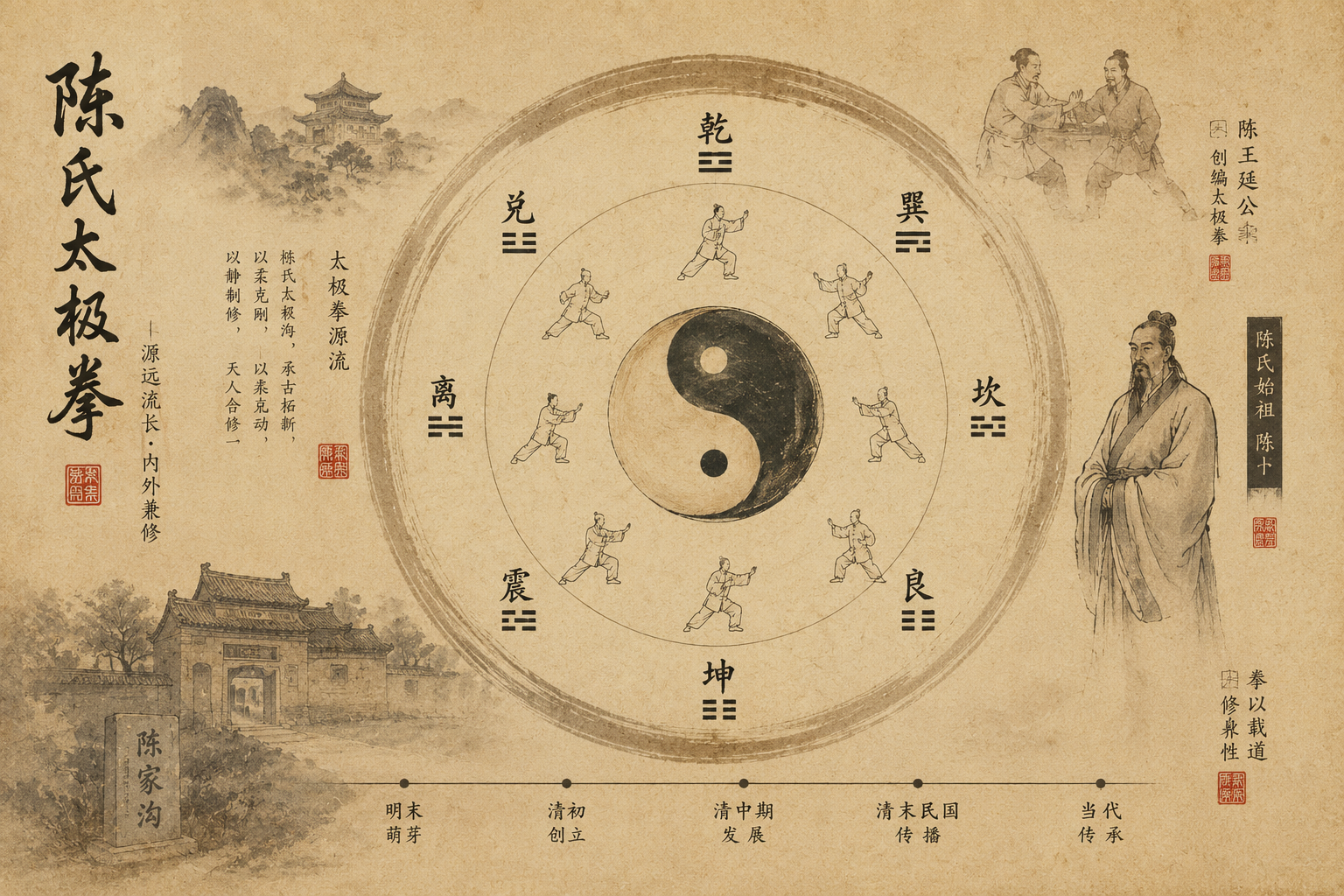
You’ve seen it in parks. Maybe in a movie. Old people moving slow, arms floating like water. And you wondered: Is this Chinese? Or Japanese?
You’re not alone. Thousands of people type exactly that question into Google every month:
“Is tai chi Chinese or Japanese?”
The short answer: Tai Chi is 100% Chinese. It was born in a small village in Henan Province, China, roughly 400 years ago. It has nothing to do with Japan.
But the confusion is real — and honestly, it makes sense. Let’s go deep into the real story: where Tai Chi actually came from, why so many Westerners mistake it for Japanese, and why knowing its true origin matters.
The Real Origin: Born in Chen Village, 17th Century China
Tai Chi — or more properly, Tàijíquán (太极拳, "Supreme Ultimate Fist") — was created in Chenjiagou (Chen Village), in Wen County, Henan Province, around the late 1500s to early 1600s.
The founding figure credited with systematizing the art was Chen Wangting (陈王廷, 1580–1660), a Ming Dynasty military officer. After the Ming Dynasty fell to the Qing, Chen Wangting retired to his village and combined:
- His family’s martial arts knowledge
- Traditional Chinese medicine theory (meridians, Qi)
- Daoist breathing and meditation techniques
- Classical Chinese philosophy — particularly the Yijing (Book of Changes)
The result was a martial art unlike anything before it: one that cultivated internal energy (qi) rather than just brute force. Fast, powerful applications hidden inside slow, circular movements.
The Zhang Sanfeng Myth (And Why It’s Probably Not True)
You may have heard that Tai Chi was invented by a Daoist immortal named Zhang Sanfeng (张三丰) on Wudang Mountain — supposedly after watching a snake fight a crane.
It’s a beautiful story. And it makes for great Kung Fu movies. But most serious historians consider it legend, not history.
The Zhang Sanfeng origin story was popularized in the late 19th century by Yang-style practitioners who wanted to give Tai Chi a more mystical, Daoist lineage. It served a purpose: it made the art feel ancient, spiritual, and divinely inspired.
But the documented, verifiable lineage starts in Chen Village — not on a misty Daoist mountain.
The Journey: How Tai Chi Spread From One Village to the World
-
~1600
Chen Wangting creates the Chen family martial art in Chenjiagou. For over 200 years, it is taught only within the Chen family. -
1820s
Yang Luchan (杨露禅), an outsider servant boy, secretly learns the art by watching through a crack in the wall. When discovered, he’s so good the Chens break tradition and formally accept him as a student. -
1850s–60s
Yang Luchan moves to Beijing and teaches the Manchu imperial court. He modifies the style to be gentler — what we now call Yang Style, the most practiced Tai Chi in the world today. -
1931
Yang Chengfu (Yang Luchan’s grandson) publishes The Yang Family Tai Chi Secrets — the first widely distributed Tai Chi manual. For the first time, the art is documented for the public. -
1956
The Chinese government standardizes the 24-Form Simplified Tai Chi — the short form millions practice in parks worldwide. -
2020
Tai Chi is added to UNESCO’s Intangible Cultural Heritage list — officially recognized as a Chinese cultural treasure.
Why Do People Think Tai Chi Is Japanese?
If Tai Chi is so definitively Chinese, why does this question exist at all? A few reasons:
1. Japan Dominated the West’s Introduction to Asian Martial Arts
Judo came to the Olympics in 1964. Karate hit American pop culture in the 70s and 80s (The Karate Kid, anyone?). Japanese martial arts got to the West first and louder. For decades, many Westerners filed every Asian movement art under "karate."
2. Chinese Martial Arts Were Suppressed for a Century
From the late Qing Dynasty through the Cultural Revolution (1966–1976), traditional Chinese martial arts were often suppressed, destroyed, or driven underground. Masters fled. Manuals were burned. Entire lineages were lost.
Meanwhile, Japan was actively exporting its martial arts as cultural diplomacy. Karate, Judo, Aikido — all had organized international federations with English-language instruction by the 1960s. Tai Chi didn’t get that treatment until much later.
3. The "Zen" Aesthetic Confusion
Tai Chi’s slow, meditative quality feels "Zen-like" to Western eyes — and Zen is strongly associated with Japan. But Zen itself is originally Chan Buddhism (禅), which came from China to Japan centuries earlier.
The flowing robes, the quiet focus, the minimalist aesthetic — these things look Japanese in the Western imagination, but they’re equally (if not more) Chinese in origin.
Tai Chi vs. Japanese Martial Arts: A Quick Comparison
| Tai Chi (China) | Karate (Japan) | Aikido (Japan) | |
|---|---|---|---|
| Origin | Henan, China (~1600) | Okinawa/Japan (~1900) | Japan (~1920s) |
| Philosophy | Daoism, Yin-Yang, Qi | Bushido, discipline | Harmony, non-resistance |
| Movement | Slow, circular, continuous | Linear, explosive, stop-start | Circular, joint-locking |
| Core Principle | Yield and redirect (以柔克刚) | Strike first (一击必杀) | Blend and throw |
| Health Focus | Primary (Qi cultivation) | Secondary | Secondary |
| Internal Energy | Central — Qi, Dantian | Kiai (shout), limited | Ki — similar concept |
Note that Aikido shares some surface similarities with Tai Chi — circular movements, joint locks, harmony philosophy. This is not a coincidence. Founder Morihei Ueshiba was influenced by Chinese internal arts, and some scholars believe Aikido’s concept of ki is directly borrowed from the Chinese concept of qi. But Aikido is a 20th-century Japanese synthesis — not the source.
Why Does This Matter?
You might wonder: does it really matter where Tai Chi comes from, as long as it works?
Yes. Here’s why.
1. The Instructions Are Embedded in Chinese Thought
When a Tai Chi teacher says "sink your qi to the dantian" or "separate yin from yang" — these aren’t metaphors you can translate into any language without loss. They come from a specific Chinese philosophical framework. Understanding the Chinese origin helps you understand the art itself.
2. The Medical System Is Chinese, Not Japanese
Tai Chi’s health benefits — improved balance, lower blood pressure, reduced inflammation — are explained through Traditional Chinese Medicine (TCM), not Japanese Kampo or Western anatomy. The meridian system, the concept of Qi, the five elements — these are Chinese. If you practice Tai Chi for health, you’re engaging with a Chinese medical tradition.
3. Respecting Origins Matters
When you strip a cultural practice of its origin, you lose what makes it meaningful. Tai Chi survived wars, revolutions, and suppression. Generations of Chinese masters protected these teachings with their lives. Knowing this adds depth to every movement.
And honestly — in a world where cultural erasure happens quietly, giving correct attribution is the bare minimum of respect.
Tai Chi Today: Bigger in China Than Ever
Walk through any Chinese city at dawn and you’ll see it: hundreds of people in parks, on riverbanks, under trees — moving together in slow, synchronized patterns.
Tai Chi is not some dying art preserved only in museums. It’s a living, breathing practice with over 100 million regular practitioners in China alone. The Chinese government promotes it as a national health treasure. Universities teach it. Hospitals prescribe it.
And now, with UNESCO recognition and global interest in mindfulness and longevity, Tai Chi is spreading faster than ever — this time, with its Chinese origin clearly known and celebrated.
Go Deeper: The 8 Gates — Tai Chi’s Original Framework
Now that you know where Tai Chi comes from, learn how it actually works. Our free 8 Gates of Tai Chi guide explains the eight fundamental energies (Peng, Lü, Ji, An...) that every Tai Chi movement is built upon — with diagrams and practice cues.
Get the Free 8 Gates GuideFree to read online. Want the printable reference card? Enter your email for the PDF.
Frequently Asked Questions
Is Tai Chi Chinese or Japanese?
Chinese. Tai Chi (Tàijíquán) was created in Chen Village, Henan Province, China, around 400 years ago. It has no Japanese origin.
Is Tai Chi related to Karate?
No. Karate developed in Okinawa/Japan with influence from Southern Chinese Kung Fu, but Tai Chi is a completely separate lineage. They share no direct relationship.
What does "Tai Chi" mean?
Supreme Ultimate (太极, Tàijí). It refers to the highest principle in Chinese philosophy: the interplay of Yin and Yang that gives birth to all things. The full name, Tàijíquán, means "Supreme Ultimate Fist."
Did Tai Chi come from Buddhism or Daoism?
Daoism. While Tai Chi incorporates philosophical elements from Daoism (Yin-Yang theory, Qi cultivation, non-action), it was created as a martial art, not a religious practice. The legendary connection to Daoist priest Zhang Sanfeng is widely considered mythological.
Why do old Chinese people practice Tai Chi in parks?
Because it works. Tai Chi is low-impact, improves balance, reduces stress, lowers blood pressure, and builds community. It’s essentially China’s national morning exercise — and it’s been that way for generations.